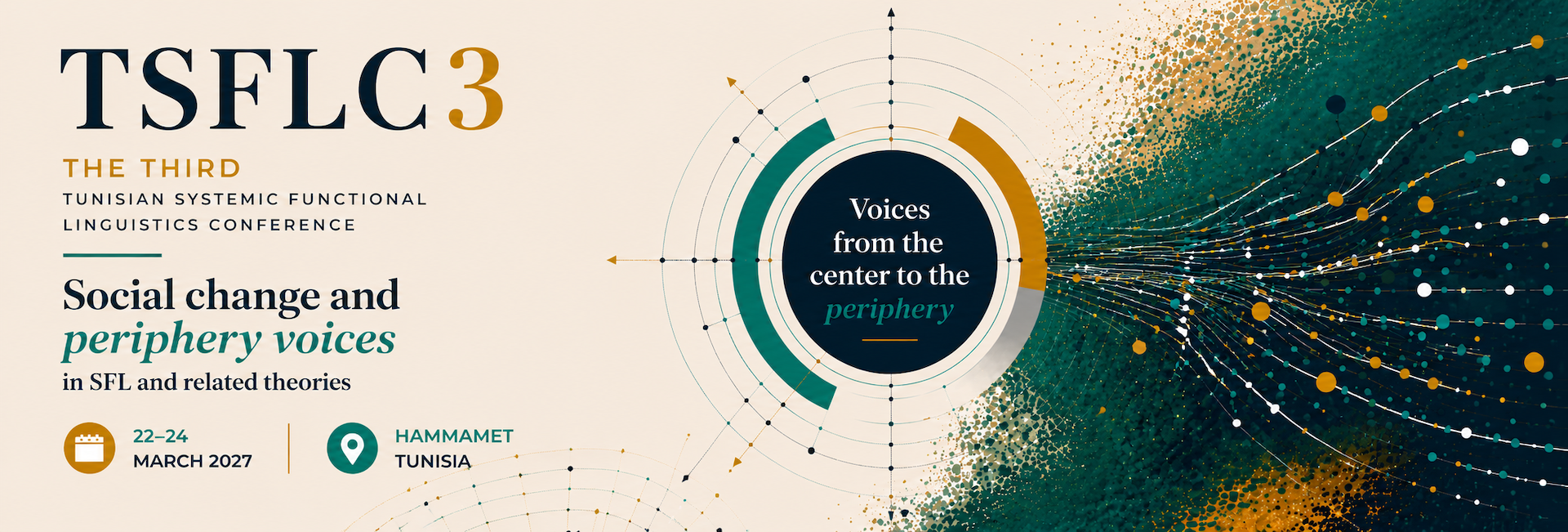
Social Change and Periphery Voices in SFL and Related Theories
We are pleased to invite submissions for the 3rd Tunisian Systemic Functional Linguistics Conference (TSFLC 3). This edition focuses on the role of SFL in understanding and shaping social change, particularly through perspectives emerging from the margins and peripheries in diverse semiotic and social practices.
Systemic Functional Linguistics sees language as a social semiotic act that not only maintains and supports the existing eco-social order, but also “nudg[es] it in the directions in which that eco-social order is going to change” (Halliday, 2013, p. 36). As an inclusive theory grounded in the relationship between meaning and context, SFL offers powerful tools that help understand how power and meaning are distributed between a dominant center and a marginalized periphery and how social change can be initiated by marginalized groups. This relationship is fractal in nature and appears across different strata of SFL theory. For example, we observe it in the experiential grammar, where the “nuclear” Process is distinguished from an expanding circle of peripheral circumstances and where Participants are either central or marginal (Halliday & Matthiessen, 2014). It is likewise apparent in interpersonal meanings through Appraisal and the modelling of evaluation, heteroglossia, solidarity, stance, and (dis)alignment as resources for construing audiences and collectivities (Martin & White, 2005). The dynamics of center and margin can also be observed within the textual dimensions, enabling us to make sense of how information is prioritized through Thematization (Berry, 2013) and how different semiotic modes (visuals vs. text) negotiate special arrangements, centrality vs. satellites, or degrees of salience (Wegener, forthcoming; Zappavigna, 2026).
In the social distribution of meaning, institutional power validates central ways of meaning while treating others as socially peripheral (Hasan, 2009). Meanwhile, within the tension of Individuation, the specific “repertoire” of the individual voice must constantly negotiate its alignment with, or opposition to, the “reservoir” of the community culture (Bernstein, 2000). Comparable semiotic pressures are now extending into human-AI interactions, giving rise to major controversies about AI roles and biases.
In this era marked by rapid social and technological transformations, the rise of marginalized voices and the growing emphasis on individual agency, we contend that mainstream SFL along with SFL-aligned frameworks and methodologies can offer valuable tools for understanding and interpreting these shifts.
Against this backdrop, this conference invites contributions that explore, extend, or challenge these perspectives. Contributions can take the form of paper presentations, panels/colloquia, posters, and workshops pertaining, but not restricted, to the following themes:
Individualism and collectivism in theories, social and digital contexts and research methods
The center and periphery/margin in theories, arts, social contexts and research methods
SFL and meaning making across human and non-human interactions
SFL and multimodality
SFL and Ecolinguistics
SFL and transdisciplinary theories and methods
SFL and professional, institutional and specialized discourses and contexts
SFL, translanguaging, multilingualism and language policies
SFL and translation
SFL and decolonization
SFL and educational applications
SFL and individuals with specific (dis)abilities
SFL and usage-based approaches to language learning and teaching