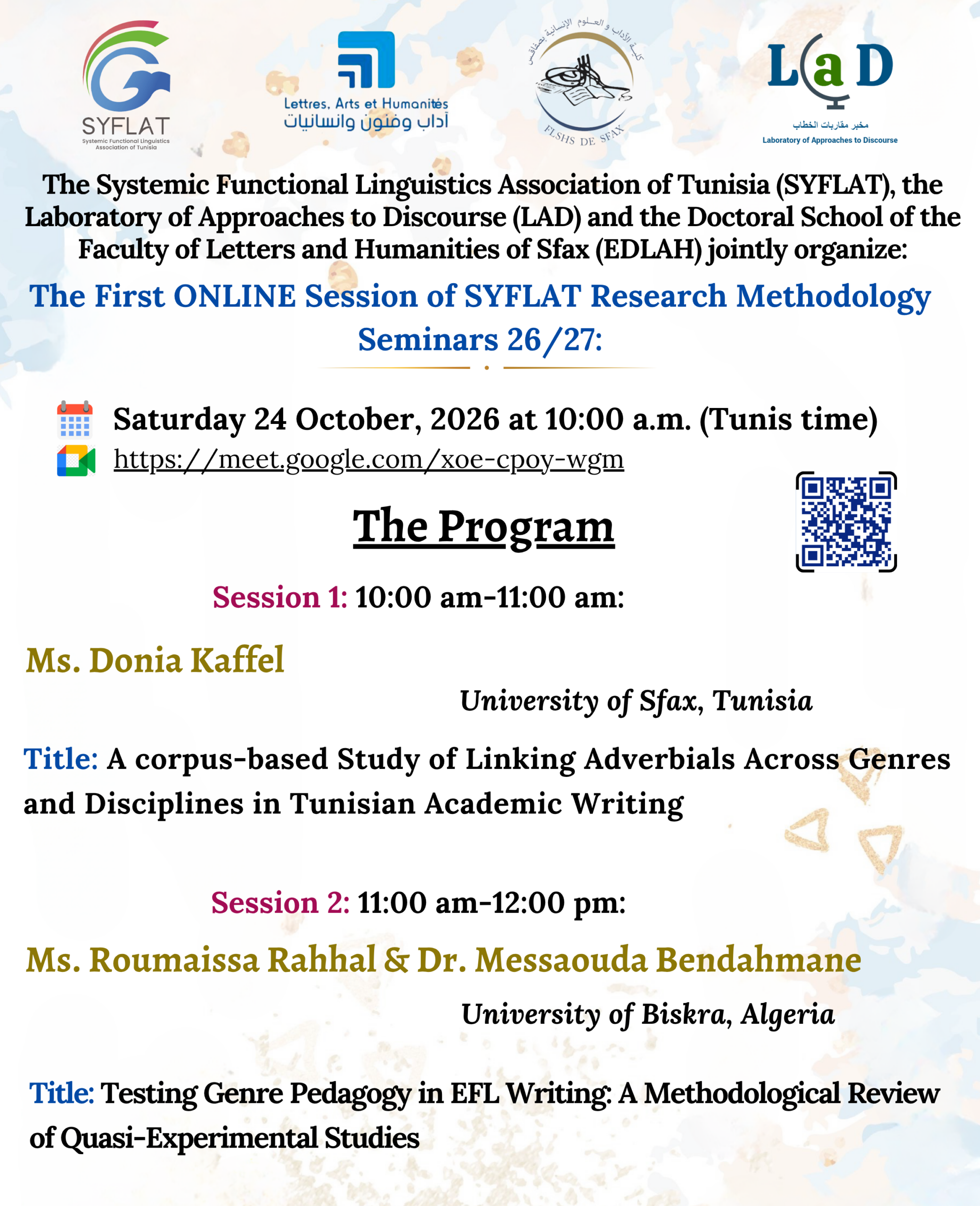
The First SYFLAT Research Methodology Webinar 2026/2027
The Program
Session 1: 10:00 am-11:00 am:
Ms. Donia Kaffel – University of Sfax, Tunisia
Title: A corpus-based Study of Linking Adverbials Across Genres and Disciplines in Tunisian Academic Writing
Session 2: 11:00 am-12:00 pm:
Ms. Roumaissa Rahhal & Dr. Messaouda Bendahmane – University of Biskra, Algeria
Title: Testing Genre Pedagogy in EFL Writing: A Methodological Review of Quasi-Experimental Studies
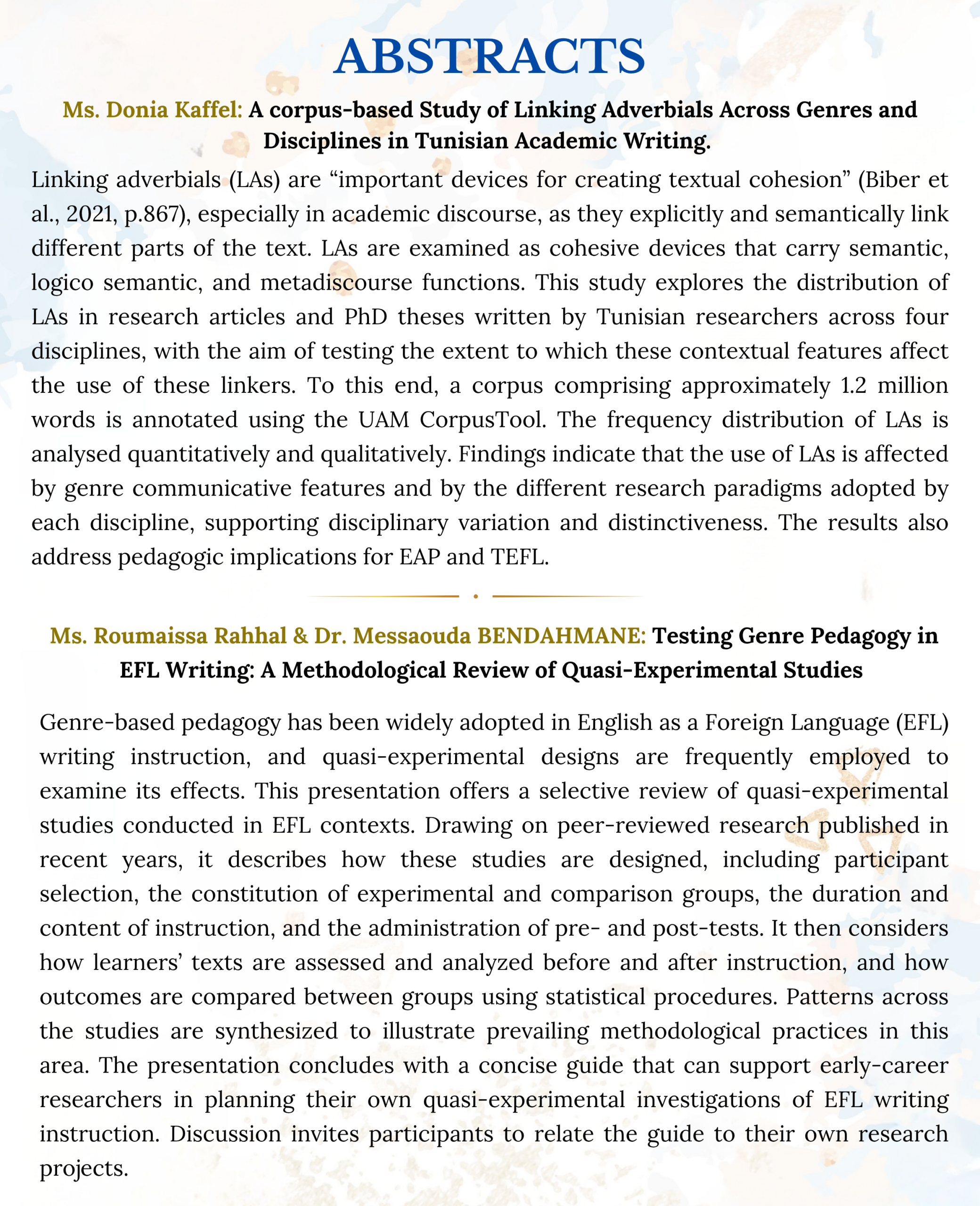
Abstracts
Ms. Donia Kaffel: A corpus-based Study of Linking Adverbials Across Genres and Disciplines in Tunisian Academic Writing.
Linking adverbials (LAs) are “important devices for creating textual cohesion” (Biber et al., 2021, p.867), especially in academic discourse, as they explicitly and semantically link different parts of the text. LAs are examined as cohesive devices that carry semantic, logico semantic, and metadiscourse functions. This study explores the distribution of LAs in research articles and PhD theses written by Tunisian researchers across four disciplines, with the aim of testing the extent to which these contextual features affect the use of these linkers. To this end, a corpus comprising approximately 1.2 million words is annotated using the UAM CorpusTool. The frequency distribution of LAs is analysed quantitatively and qualitatively. Findings indicate that the use of LAs is affected by genre communicative features and by the different research paradigms adopted by each discipline, supporting disciplinary variation and distinctiveness. The results also address pedagogic implications for EAP and TEFL.
MS. Roumaissa Rahhal & Dr. Messaouda BENDAHMANE: Testing Genre Pedagogy in EFL Writing: A Methodological Review of Quasi-Experimental Studies
Genre-based pedagogy has been widely adopted in English as a Foreign Language (EFL) writing instruction, and quasi-experimental designs are frequently employed to examine its effects. This presentation offers a selective review of quasi-experimental studies conducted in EFL contexts. Drawing on peer-reviewed research published in recent years, it describes how these studies are designed, including participant selection, the constitution of experimental and comparison groups, the duration and content of instruction, and the administration of pre- and post-tests. It then considers how learners’ texts are assessed and analyzed before and after instruction, and how outcomes are compared between groups using statistical procedures. Patterns across the studies are synthesized to illustrate prevailing methodological practices in this area. The presentation concludes with a concise guide that can support early-career researchers in planning their own quasi-experimental investigations of EFL writing instruction. Discussion invites participants to relate the guide to their own research projects.